
Rebecca Greenberg-Ellis: The Case for Connecticut’s Next Charter Chapter, and Why I’m All In
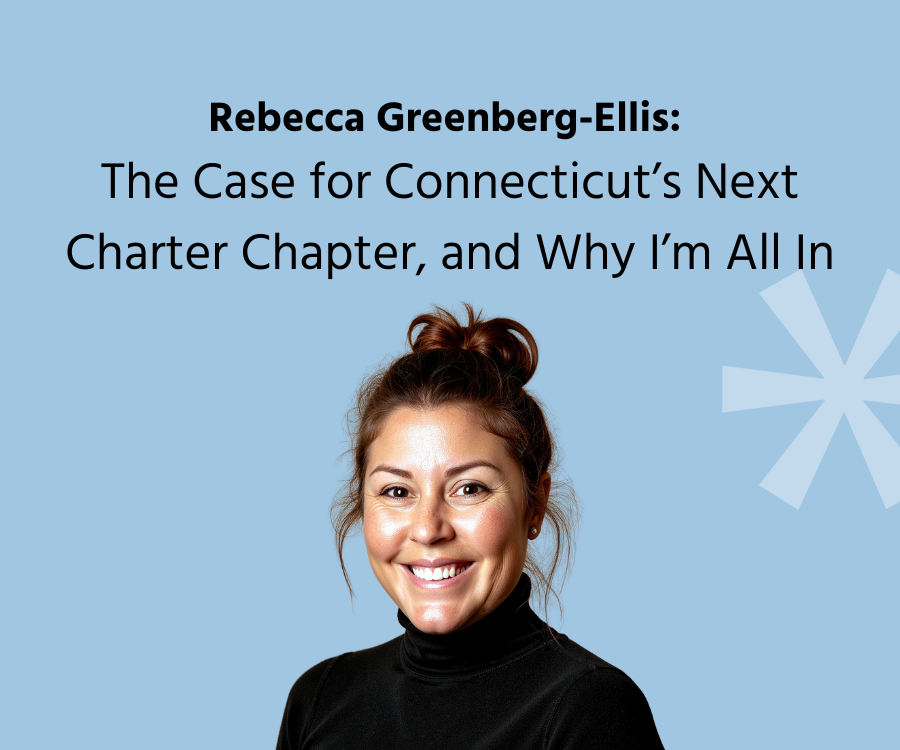
It’s hard to believe, but I’ve been part of the Connecticut charter school movement for more than 15 years.
When my husband and I moved to Connecticut as newlyweds in 2009, we didn’t think we were laying the groundwork for a long-term life here. Our honeymoon was the cross-country road trip that brought us to our new home outside New Haven. We assumed we’d stay for four years – just long enough for him to finish graduate school and for us to start a family closer to my parents.
Shortly after arriving, I landed a job at ConnCAN in New Haven, and it felt like kismet. I had explored teaching as a career during and after college, spending time as a special education paraeducator in California. That short period in the classroom taught me a few important lessons: teaching is far harder than most people recognize, I wasn’t equipped to be a successful classroom educator, and what happens inside schools is shaped dramatically by public policy crafted at the state level. ConnCAN became the place where I could combine my business degree, and my love of clear goals and measurable outcomes, with the world of public education.
During my years at ConnCAN, I immersed myself in the public charter school sector. I learned how charter schools were approved, funded, and governed in Connecticut. I spent time inside the schools, watching theory and school design turn into practice. I saw how a school like Common Ground High School balances rigorous academics with project-based learning. I watched Achievement First expand across three cities, evolving into a multi-regional network. We cheered as Brass City Charter School opened in Waterbury and built a school culture grounded in love, joy, and acceptance. And we celebrated a milestone moment in 2014, when four new charter schools — Capital Preparatory School, Great Oaks Charter High School, Excellence Community School and Booker T. Washington Academy — were approved in one year.
Of course, there were challenges as well. School leaders wrestled with budget shortfalls caused by state funding gaps between charter and traditional district schools. They tried to demystify what charter schools are (and are not) for elected officials and municipal leaders. And they endlessly struggled to find and finance safe, functional facilities in the absence of state facilities aid.
After four years at ConnCAN, I transitioned to 50CAN, the national network that grew out of the ConnCAN model. Our team launched advocacy fellowship programs in states and cities across the country, equipping community members to push for student-centered change at school board meetings, in their neighborhoods, and at state capitols. The 50CAN network grew, but at home in Connecticut, progress slowed. By the time I left 50CAN in 2018, Connecticut hadn’t opened a new charter school in nearly five years.
The next chapter of my career took me to The Peter and Carmen Lucia Buck Foundation, where I led K-12 education investments across Connecticut and New York City. My work as a program officer brought me back into schools regularly. I asked leaders what kept them up at night, learned about their operational challenges, and partnered with them to strengthen their school models. Supporting these schools with resources and partnership was an extraordinary privilege. But even as the charter sector matured and flourished in many ways, no new schools opened in Connecticut after 2014. Wait lists for charter schools continued to grow.
So, when Connecticut’s State Department of Education released a long-awaited Request for Proposals in 2022, we moved quickly to encourage charter leaders both local and national to apply. The result was the approval of two new schools in 2023 and five more in 2025. Two new charter schools opened their doors to kids in the fall of 2025. It’s clear that we are standing at the edge of real momentum.
Connecticut’s charter landscape is strong. The vast majority of schools outperform their host districts in math and ELA, and several outperform the state average. We also have a committed and robust advocacy ecosystem led by people who care deeply about kids and families, and who are relentless in their pursuit of policy that lifts up every community.
In 2024, The Mind Trust began work in Connecticut at the invitation of multiple partners in the statewide charter school space. For two decades, The Mind Trust has partnered with schools, civic leaders, families, nonprofits, and state leadership to grow and sustain a high-quality public charter school sector in Indiana. Their results are remarkable, and the lessons from Indianapolis will be essential as we chart Connecticut’s next decade.
When I was asked to lead The Mind Trust’s work here, saying yes was easy. It felt like coming home – not just geographically, but professionally. The Mind Trust’s emphasis on school excellence, the importance of research and data, and the value of community voice is exactly what matters to me too. Doing this work with partners across Connecticut feels purposeful (and honestly, a lot of fun).
In the coming years, we’ll be building across four pillars: incubating new schools that communities want and need; supporting existing schools to strengthen academics, operations, and long-term planning; identifying and solving systemic challenges facing the sector; and developing the talent needed to support growth. And while this work points toward the future of education in Connecticut, it’s also deeply personal for me.
Connecticut was never meant to be my family’s long-term home, but over time our roots grew deep. We welcomed our daughters here, and bought our first house here. I began serving on the Region 4 Board of Education in 2017, and my husband built a career caring for kids at Connecticut Children’s Medical Center. This small but mighty state has its hooks in us.
Being part of the charter school movement has been the joy of my professional life. And as Connecticut stands on the edge of long-overdue growth, I’m ready to roll up my sleeves – because our students deserve a system bold enough to meet their potential, and this is the moment to build it.