
Inside the North Star Fellowship: Leaders Driving Change in Connecticut Education
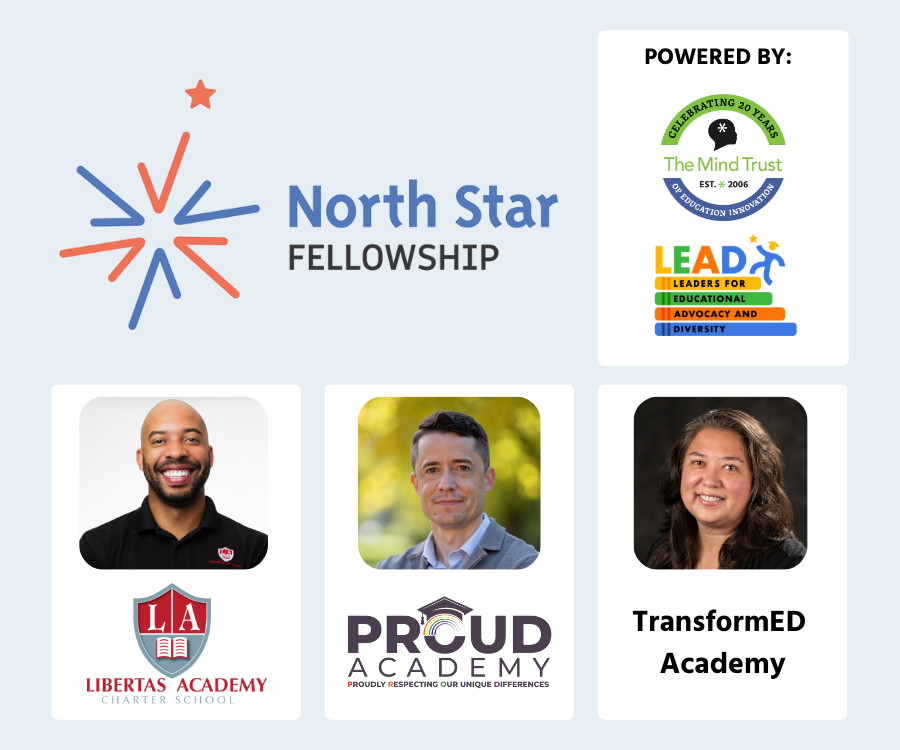
The North Star Fellowship, a collaboration between The Mind Trust and Leaders for Educational Advocacy and Diversity (LEAD), is a paid, full-time leadership program designed to equip aspiring school leaders with the tools, mentorship, and strategic guidance needed to launch high-quality public charter schools in Connecticut. Through the Fellowship, participants develop their governance and leadership skills, refine their school models, evolve their financial preparation, advance their facilities planning, and build meaningful connections with other local leaders— ensuring their schools are deeply rooted in and responsive to the communities they serve.
Recently, the Mind Trust team sat down with each North Star Fellow to explore their leadership journeys, the experiences that shaped them, and the values that drive their work. Together, these conversations surfaced each Fellow’s personal “why,” the vision for their school, and the steps they’re taking to create meaningful opportunities for students and families across Connecticut.
“Our North Star Fellows are deeply committed to their communities and bring a clear sense of purpose to this work,” said Georgia Lieber, Partner, North Star Fellowship at The Mind Trust CT. “They’re designing schools that honor local voices and create meaningful opportunities for students and families. Each is translating their passion for a high-quality education for all into concrete plans that will expand opportunity and reimagine what public education can look like for Connecticut families.”
Modesto Montero-Forman: Libertas Academy Charter School (LACS)
Libertas Academy Charter School (LACS), the Springfield, MA school that Modesto Montero-Forman founded in 2017 and is hoping to launch in Connecticut, focuses on preparing students for college and beyond by removing barriers that might limit their opportunities. While the school’s model emphasizes high expectations and college readiness, Modesto’s current focus is on cultivating trust and building relationships in the community. By attending events and holding one-on-one listening sessions with key stakeholders, he is learning firsthand how to engage families and gain community support. Looking ahead, he hopes that in five years, LACS will not only serve as a model of excellence for every student but also demonstrate what is possible when schools and communities collaborate to raise the bar for all learners. In his own words, he wants the school to be “another proof point for what is possible because it’s what our students deserve.”
Through the North Star Fellowship, Modesto and his team have been navigating the unique landscape of Connecticut education while refining their approach to expansion. He describes the process as an “eye-opening experience” that has fueled their passion to bring another great school to families in the state. Exposure to national partners and resources has helped the team think bigger and reimagine their work, including codifying their college access program to maximize impact. Modesto also emphasizes the importance of intentional community engagement, noting that they “have to work to build trust within our community, and this will take time, but we are committed to doing this important work.”
Modesto Montero-Forman’s journey into education is deeply rooted in both personal experience and a commitment to fairness. Born in the Dominican Republic and raised by his grandmother and extended family while his parents worked in the United States, Modesto reunited with his parents in fifth grade and attended schools in a predominantly white, middle-class town in Massachusetts. That experience, attending high-quality schools simply due to circumstance, made him acutely aware of the educational differences that exist nationwide. Reflecting on that realization, he said, “It both broke my heart and inspired me to pursue a career in education.” Over the past 15 years, he has dedicated himself to providing excellent education for all students from under-resourced communities.
“We’ve really appreciated the opportunity to connect with so many different national partners. The exposure to different resources and partnerships has helped us to think bigger and reimagine how we do our work. Having external folks look under the hood and push our school has the potential to have a transformative impact on our school and our students.”
David Brown: PROUD Academy (PROUD)
PROUD Academy (PROUD) is envisioned as a small, relationship-centered middle school that partners with local organizations to extend learning beyond the classroom. While the school’s model provides rigorous academics, social-emotional learning integration, and community-based enrichment, the work David Brown is most proud of comes from building a foundation of trust and engagement across Ansonia. From listening sessions with families to one-on-one conversations with community leaders, he has cultivated a network of advocates who are deeply invested in the school’s success. Looking ahead, Brown hopes to see students thriving: “I want to see students thriving—closing learning gaps, taking on leadership roles, contributing to civic life, and seeing futures for themselves that feel possible and exciting.” Through the fellowship, Brown has not only strengthened his school model but also his leadership capacity, emerging with a clearer sense of purpose and a design that reflects both his experience and the needs of the families he serves.
Through the North Star Fellowship, Brown has refined both his vision and approach. “Working alongside other fellows has been energizing, especially learning from leaders designing models very different from PROUD Academy. Working alongside other fellows has been energizing, especially learning from leaders designing models very different from PROUD Academy. Seeing both innovative and operationally strong school designs pushed me to think more clearly and intentionally about what defines PROUD’s unique contribution to the Valley,” he said. The program helped him evolve PROUD Academy from a model initially aimed at a specific student population into a community-responsive school designed to meet the needs of all learners in the Ansonia area. Fellowship sessions, coaching, and collaboration encouraged him to simplify complexity, sharpen priorities, and ground every decision in the local context and family voice. He also learned that consistency, clarity, and structured systems—rather than innovation for its own sake—are what families value most, guiding PROUD’s mission centered on academic rigor, belonging, strong relationships, and clear communication.
Brown grew up in a small coastal CT city surrounded by creativity, hard work, and potential, but also by school systems that didn’t always reflect the strengths or needs of students like him. As a child with ADHD, Brown thrived in hands-on, artistic, and experiential learning environments, yet found traditional school models rigid and limiting. That early experience shaped his understanding of what it means for learners to feel seen and supported, and it became the foundation of his work as an educator and, ultimately, as the founding leader of PROUD Academy. Over the years, he has served as a STEM teacher, instructional coach, and high school principal, witnessing firsthand how difficult it can be for large systems to implement timely, meaningful change for students.
“The cohort’s collaborative spirit and vulnerability strengthened my own decision-making and reflection. The Mind Trust team has been equally valuable, grounding every idea in research, feasibility, long-term impact, and strong operational systems. Their coaching helped me translate the mission into a school design that is both ambitious and executable.”
Dr. Monica Brase: TransformED Academy (TEDA)
At the core of TransformED Academy (TEDA) is a commitment to re-engaging disconnected youth through competency-based education, including project- and work-based learning. Through the North Star Fellowship, Dr. Monica Brase has sharpened and solidified her vision for how that model comes to life in practice. The fellowship helped her move from a broad belief in competency-based education to a clearer philosophy around curriculum, one that provides structure and guidance for teachers without relying on scripted instruction. School visits in cities like New York, Indianapolis, and Atlanta reinforced what was possible, showing her that other schools serving similar student populations are already building flexible, student-centered models. “It’s helpful to know there are other schools doing things with flexibility,” she shared, noting how affirming it has been to see educators creating systems that reflect the needs of disengaged learners.
Dr. Brase’s commitment to reimagining education began early in her teaching career, during her first year at Buckley High School. As a new teacher, she was assigned to teach general-level classes made up of students with significant academic and behavioral challenges—some as old as 18 but still classified as freshmen due to credit deficits. Despite the barriers they faced, she recalls students arriving eager to learn, excited to ask what the day would bring, even as they struggled within an overcrowded school environment. “This is not the right environment for students,” she remembers thinking at the time. Those experiences affirmed her belief that young people who are disengaged from school don’t need less—they need something different: a smaller, more intentional learning environment designed to meet them where they are and re-engage them in meaningful ways.
Working alongside other North Star Fellows and The Mind Trust team has also strengthened Dr. Brase’s ability to articulate, question, and refine her ideas. The fellowship has pushed her to ask hard questions, be vulnerable in sharing her thinking, and clarify what makes TEDA distinct, especially as she navigates the challenge of building relationships in spaces that may be skeptical of charter schools. At the same time, community conversations have reinforced the need for a school like TEDA in the Hartford area, particularly one that connects students to career exploration and community-based learning. Looking ahead, Dr. Brase hopes the school will not only re-engage students in their education but also empower them to make a lasting impact beyond the classroom. “It’s transformative education, transforming the community and students alike,” she said, describing a vision where students are prepared for their next phase of life while contributing meaningfully to the communities they call home.
“Working with the fellows and The Mind Trust helps me question what we are doing and then solidify my beliefs. They also help me make sure that I am clearly articulating ideas or able to answer the tough questions.”
About The Mind Trust
The Mind Trust is an Indianapolis-based education nonprofit that works to build a system of schools that gives every student, no exceptions, access to a high-quality education. The Mind Trust does this by building a supportive environment for schools through policy and community engagement, empowering talented, diverse educators to launch new schools, and providing existing schools with the support they need to hire world-class talent and achieve excellence. Since 2006, The Mind Trust has supported the launch of more than 50 schools, 15 education nonprofit organizations, and has helped place over 2,000 teachers and school leaders in Indianapolis.