
Brown University study finds Indiana charter schools outperform traditional districts on pandemic learning recovery
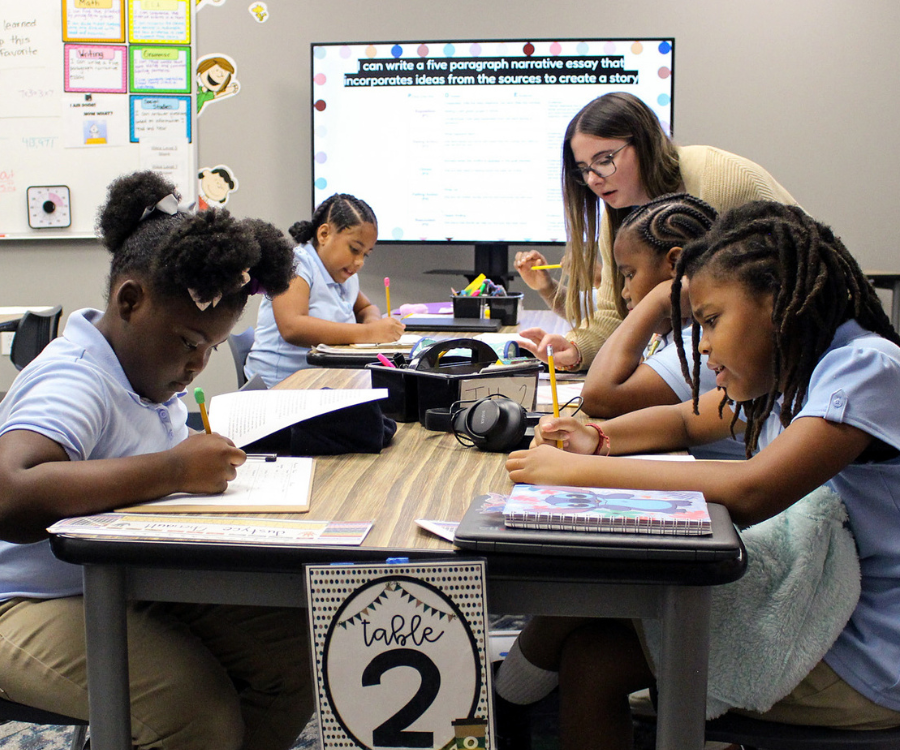
A new study from the Annenberg Institute at Brown University found that Indiana public charter school students made significantly greater post-pandemic learning gains than their peers in traditional district schools. The gains were largest for Black, low-income, and academically low-performing students.
Following the COVID-19 pandemic, students across Indiana saw significant learning loss. In 2021, the first year students took a state assessment after the pandemic began, Hoosier students statewide saw an 8.5 point combined proficiency decrease from the 2019 ILEARN assessment, going from a combined 37.1% pass rate to 28.6%. These drops were more serious for vulnerable student groups, such as low-income students and students of color.
This study is the first to examine Indiana’s charter school performance following the pandemic. Researchers used state assessment data provided by the Indiana Department of Education for schools that were open each year analyzed by researchers. Only students who attended a charter or traditional district school throughout the entire research period were included in the analysis.
Overall, in 2022, 2023, and 2024, Indiana charter school students achieved larger learning gains than their peers in traditional district schools. English Language Arts (ELA) gains for Indiana charter schools were statistically significant each of these years, and math gains were statistically significant for every year but one.
By 2024, Indiana charter students regained their pre-pandemic achievement levels in math and surpassed their pre-pandemic achievement levels in ELA. Researchers found that traditional district schools still lag behind their pre-pandemic achievement levels in both math and ELA.
Recent legislation in 2025 and 2026 will help to close some of the funding gap between charter schools and traditional district schools in years to come. Indianapolis charter schools, where the majority of these schools in the state are located, operated with a funding gap of $7,900 during the years this study measures, underscoring their ability to serve families well despite having fewer resources than traditional district schools.
Statistically significant effects for multiple student groups
The study found that Black Indiana charter school students had especially impressive gains. From 2022 to 2024, Black students made statistically significant gains each year in ELA and math. Those effects grew stronger every year, resulting in a 10 percentile point change in a single school year.
Low-income students in Indiana charter schools and those who were academically low-performing prior to the pandemic also made statistically significant gains in ELA and math in 2022, 2023, and 2024. Indiana charter students in special education made statistically significant gains in 2023 and 2024. Latino and English Language Learner charter students made significant learning gains in 2023 and 2024.
This study follows years of research on Indianapolis charter schools. In 2022, Stanford University’s Center for Research on Education Outcomes (CREDO) found that Indianapolis charter schools achieved 64 days of additional learning in ELA and 116 days of additional learning in math relative to their peers in district-run IPS schools. A 2023 study from the University of Arkansas found that Indianapolis is the most cost-effective charter sector in the country for both reading and math achievement.
Another 2023 study by researchers from University of Washington, the University of Kentucky, and the University of Notre Dame found that charter schools authorized by the Indianapolis Mayor’s Office produce significant positive impacts on student achievement. These findings accompany multiple years of strong performance by Indianapolis charter schools on the ILEARN and SAT.
Today, charter schools across Indiana serve more than 56,000 students across the state, with enrollment continuing to grow. As an increasing number of Hoosier families select charter schools as the option that works best for their students, these study findings show strong evidence for further investment and support for their growth.