
Emerging and Leading: Cohort 2 Is Two-Thirds In with More to Give
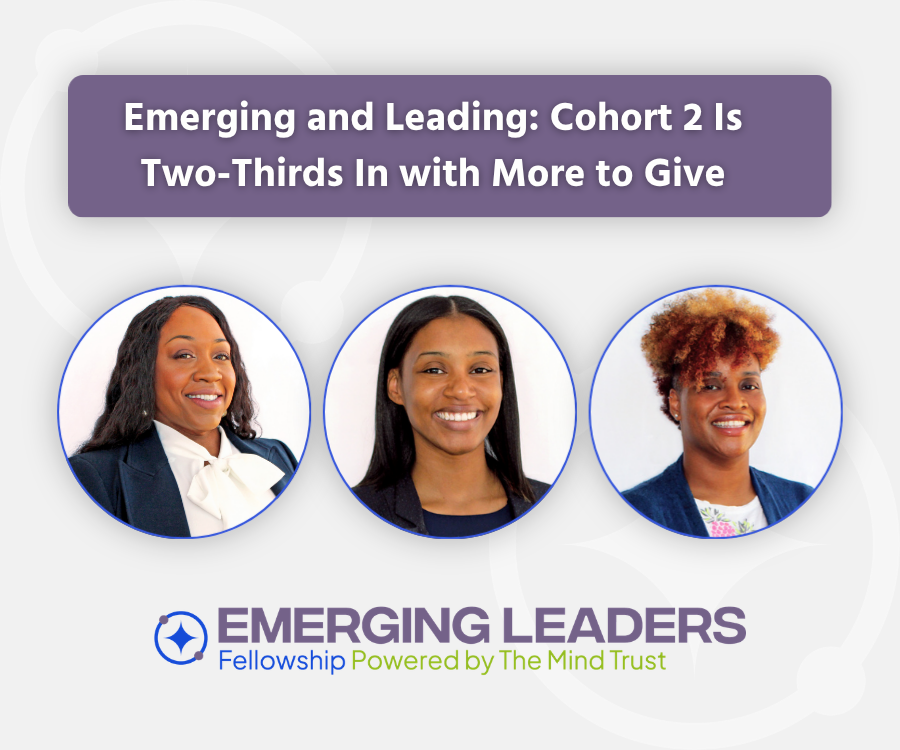
This is part 1 of the Emerging Leaders Fellowship (ELF) series, Emerging and Leading, a three-part celebration of the educators in ELF Cohorts 2, 3, and 4.
Two years is enough time to evolve as a person. Not just professionally, but also in how a leader sees themselves, their team, their school, and their city. Cohort 2 of the Emerging Leaders Fellowship entered the program in the summer of 2024 with big goals and a healthy dose of uncertainty. Today, two years in, they are sharper and more committed than ever to the students and communities they serve.
The Emerging Leaders Fellowship is structured as a three-year journey. Year 1 is focused on self: who you are as a leader, what you value, and how you show up. Year 2 expands that lens to the school level: how you lead your team, build systems, and drive impact inside your building. Year 3 zooms out to the systems level: how you contribute to the broader landscape of education leadership across Indianapolis. Cohort 2 is two-thirds of the way through that journey, and the growth they have made in Years 1 and 2 is exactly what you will see reflected in the stories below.
JaCinda DeVance, 4-8 Assistant Principal at The PATH School
JaCinda DeVance came into ELF as a veteran educator with 17 years of experience in special education and with a clear-eyed sense of what she still wanted to learn. This year brought more change than she could have anticipated: a mid-year transition into dual roles as both 4-8 Assistant Principal and Director of Exceptional Learners at The PATH School. She leaned on the fellowship to develop exactly the leadership muscles her expanded role demanded.
Her growth over two years has been anchored in one defining shift: learning to let go. DeVance has leaned into collaborative leadership, delegation, and the art of building others’ capacity. “Being collaborative has been the biggest stretch for me,” she shared. “Just being able to reach out to others and know that I can’t hold it all. I have to give it to someone else so that we can all meet the common goal.”
A quote has guided her through Year 2: “Be so dangerous that you can end the chaos, but be disciplined enough to create the solution.” It is equal parts challenge and permission. It has shaped how she thinks about creating systems, building clarity for her team, and showing up as a leader even when the ground is shifting.
A fellowship school visit to Purdue Polytechnic High School’s Englewood campus left a lasting mark. Exceptional learners scholars confidently led the tour, advocated for themselves, and demonstrated deep knowledge of their own Individualized Education Programs. For someone who has devoted nearly two decades to special education, it was a profound reminder of what is possible when students are truly seen and supported.
As she looks ahead to Year 3 and the fellowship’s systems-level focus, DeVance is ready. Her goal: to build bigger, better systems, not just for The PATH School, but for leaders across the Indianapolis landscape. She describes the impact of ELF in one word: “Transformational.” And she means it. “ELF has leveled up my leadership skills in ways that I didn’t think could happen so fast,” she said. “But it has.”
Her advice to a new fellow: “Be open, be honest, lean into uncomfortability so that you can grow and be stretched.”
Lydia Glover, K–3 Assistant Principal at The PATH School
When Lydia Glover entered the Emerging Leaders Fellowship, she was in her first year of formal leadership, eager to learn but still figuring out her leadership philosophy. Two years later, she has not only found that philosophy; she has built a daily practice around it.
The most significant shift for Glover over the course of the fellowship has been in how she sees her team. Early on, she viewed staff as people who could take things off her plate. Now, she asks a completely different question: how can I pour into my staff? “What are they passionate about right now? What are some of the strengths that they have that I can use to build capacity in them?” Reframing them as people to genuinely invest in has changed everything about how she shows up as a leader.
The biggest challenge she navigated this year was earning teacher buy-in through significant school-wide shifts, including a full curriculum change. Rather than issuing top-down mandates, Glover is learning to co-create solutions with her team. “It’s not just about listening to what they’re complaining about,” she said. “It’s about asking what kind of action steps you think you’d need in order to help solve this problem.”
One of the fellowship’s most meaningful resources has been Glover’s executive coach, Ambrosia, someone who knew her school, her scholars, her specific questions about the future, and who could provide personalized support that most professional development simply cannot offer. “Being able to have someone that knows me, knows what I’m doing, knows my school, that has been very, very helpful,” she said.
A visit to Purpose Prep, a K–5 school in Nashville, Tennessee, gave Glover a powerful lesson in distributed leadership. The school’s clearly defined roles meant no one was picking up anyone else’s slack, and the entire team moved faster and more efficiently as a result. Glover came home thinking carefully about how to build that same kind of efficiency at her school.
The most rewarding moment of her year? Watching teachers genuinely smile as they talked about how their students were performing. “That all comes from you all,” Glover tells them. “You are doing the thing to make these things happen for our kids.”
She describes ELF in one word: “Stretching.” As she puts it, “it’s uncomfortable, but at the end of the day, when you do stretch a muscle, it grows.”
Her advice to a new fellow: “If you’re looking to be the best leader you can possibly be and grow your network, ELF is the right program for you.”
Jennifer Rhinehart, Assistant Principal of Academics (9-12) at Indiana Math and Science Academy (IMSA) North
Jennifer Rhinehart is the kind of leader who doesn’t do anything halfway, and ELF has given her a place to channel that intensity into something lasting and real.
Entering the fellowship, Rhinehart was confident in her instincts but ready for a sharper leadership identity. Over two years, she has found it. She now describes herself as a “true leader,” with a deeper understanding of what it actually means to hold people accountable, articulate a vision, and ensure that vision becomes the team’s own. “I can’t work my goals out alone,” she said. “I have to utilize the people in the building. I have to get them engaged about my vision and articulate it in a way that it becomes their vision too.”
Her most impactful fellowship experience was her Impact Project, which she focused on freshmen at IMSA North. She spent significant time helping first-year high school students understand credit requirements, the real consequences of repeating classes, and the importance of self-advocating with their teachers. “I can’t be the only one concerned about their future,” she said. “They need to be invested as well.”
Her executive coach provided a critical sounding board throughout the year: someone who could offer genuine, non-evaluative feedback on the real challenges inside her building. “It was a tremendous help,” she said. A summer professional development on self-awareness as a leader also stood out to her, in which the facilitator helped Rhinehart identify her own strengths and blind spots so she could lead with greater self-knowledge and intention.
By Year 2, the cohort bond deepened significantly. What began as cordial connections became something more vulnerable and more real. “We’ve cried with each other a couple of times through some challenging moments,” she said. “But it really created a safe space for us to be able to vent if necessary, and also provide resources and problem-solve so that we can all be successful.”
The fellowship has also clarified Rhinehart’s long-term path: she wants to become a school principal. ELF has given her the confidence to believe that’s not just possible, it’s within reach. “The fellowship made me feel seen as a leader,” she said. “And it gave me the tools to really go out there and have an impact.”
She describes ELF in two words: “Stretching capacity.” And her advice to a new fellow is simple and powerful: “Come scared. It’s okay to come scared. Know that your fear will be turned into strength.”
Two Years. Still Growing.
JaCinda, Lydia, and Jennifer entered the Emerging Leaders Fellowship as strong educators who wanted more for themselves and for the students they serve. Two years later, they are more self-aware, more collaborative, more confident, and more connected to the city-wide ecosystem of Indianapolis education than ever before.
Want to learn more about the Emerging Leaders Fellows? Meet all of our current fellows at themindtrust.org/fellows. To learn more about the fellowship, visit themindtrust.org/emerging-leaders-fellowship.